• Welcome to H4O! For a reduced ad experience, please login or register with the forum.

ok, so remind me of why we can't run disconnects on the front, on the H3?

backcountryislife

Well-Known Member
Messages
858
Location
Dumont, CO
Talking to all the yota & for IFS people it seems nearly all of them disconnect, what makes the H3 so different that nobody does it on these?

The only thing that feels lacking on this thing is the front flex, and since I'm without lockers, having a bit more contact would help a ton.

Being t-lifted, we've already got down angle, so up travel would help straighten things back out, and down travel if that's an issue would be able to be limited by a strap if needed...


So what am I missing? If I snap a stock 1/2shaft, I can go to RCV shafts, which have more ability to handle articulation, but seems like there's more to it.
 

06 H3

a.k.a. "The Jackal"
Messages
9,505
Location
Meridian, ID
its not that you cant...its that most people dont recommend doing it. Personally, I havent seen anyone disconnect their sway bars and break halfshafts. I think its more perception. Seeing we have broken halfshafts with them connected by disconnecting most think it will worsen. Thats my take on it...feel free to correct me if I am wrong
 

Big2dabank

Well-Known Member
Messages
1,220
Location
Central Florida
I actually run my H2 quite a bit without the front sway bar connected, not for articulation, but to limit some rubbing I have with my Kryptonite steering setup and the sway bar when I wheel. The problem I noticed with the H2, is that the front shocks actually limit articulation more than the sway bar, so it does not make much difference. This may be similar on the H3. The other thing to consider is the more you allow the front to droop, the more extreme tie rod and half shaft angles area increase and the risk for breakage goes up. Just swapping out to stronger shafts may only expose the diff to more damage. Would you rather damage a shaft or a diff. I'll take a trail repair of a shalf any day. Food for thought...
 

Hunner

Well-Known Member
Messages
2,334
Location
Arkansas
If you don't get shocks that are 1/2 longer (or extend the ones you have), and lengthen your front swaybar links you won't get the extra travel that is there. The stock tie rods only articulate 23 degrees as opposed to Bullet Proof tie rods which will allow down to 30.
The up is solved by the vehicle just going up.
The down is also limited by the metal stop on the frame, which keeps you from overextending things including the cv shafts.
When I first discovered this back in 06 I did add straps as I was not sure if the suspension would hammer down and cause damage to the upper a-arm. I have since made several other changes and no longer run the straps.
Of course that is all subject to opinion.
nutarrow.jpg

Metalstop.jpg
 
Last edited:

06 H3

a.k.a. "The Jackal"
Messages
9,505
Location
Meridian, ID
For me, I know the rancho shocks are the limiter on my front end but I am rancho lifted so I am a different case. Talk to hunner, he has limiting straps on his front ends.

EDIT: WOAH! Hunner posts right before I said talk to hunner lol
 

Hunner

Well-Known Member
Messages
2,334
Location
Arkansas
do do do do the twilight zone...............
If you just disconnect the sway bar I think you will have problems overextending everything else. (and the Alpha has longer CV shafts)
With it disconnected, and the shock disconnected you get the 1/2 inch more plus some but only really about 1/2 usable.
_DSC6779.jpg

_DSC6777.jpg

So you can get longer sway bar links, get more travel and still have all there is and control with the sway bar.
DAH_5085-1.jpg

I still cannot always reach the ground.
DSC_3121.jpg

and travel up when it runs out lifts the front end.
mt4403.jpg
 
Last edited:

backcountryislife

Well-Known Member
Messages
858
Location
Dumont, CO
If you don't get shocks that are 1/2 longer (or extend the ones you have), or lengthen your front swaybar links you won't get the extra travel that is there.

I don't think I"m looking to get more travel, just to use what I've got. I feel like by t-lifting, we already have the suspension in a down travel position, so I'm looking to get the up travel back out of it.

I'd think that I'd want to limit the down travel like you did, but allow for more up travel.


Big2dabank, I got ya on the shafts... Neo & I were talking about that when I was out there, that makes sense. I just feel like even when I'm loaded all the way on one tire, I'm only at level again... seems like it could handle as much up travel as we've given it in down without an issue.
 

Hunner

Well-Known Member
Messages
2,334
Location
Arkansas
The H3 is using all it has with the stock set up. It's set up to use it all with stock components. You have to change things to get more.
They are using those things I mentioned to limit the travel from hammering or destroying the fixed limits.
The shock is part of that.
DAH_9731.jpg

all you have to do to test my observations is jack it up, a second jack under the suspension, disconnect all that lower the one under the suspension and see what happens.
I only limited the increased travel down until I was sure the a-arm would not get bent up coming down.
 
Last edited:

backcountryislife

Well-Known Member
Messages
858
Location
Dumont, CO
so the travel I felt in the bilsteins (ones intended for a t-lift setup) isn't possible to use without changing other stuff?


I feel like even when I'm loaded on one wheel there's nearly zero uptravel on that wheel (goes to about flat on the CV) so I'm only getting about 3-4" of travel. The shock seemed like it got more than that when i compressed it, and the leverage ratio of this setup should allow for approx 1.5x that from what I can tell.

Not trying to disagree with you, I just feel it's the increased prelaod/ sway bar keeping me from going further up.
 
Last edited:

Hunner

Well-Known Member
Messages
2,334
Location
Arkansas
You can use the longer shocks but until you lengthen the sway bar links as shown in the pictures disconnected, it will not use all of the added capability. When you do disconnect it, it lets the suspension drop more. Then you get into tie rods an cv shaft limits at some point.
However in my set up I want the sway bar I just want it to allow more travel before it comes into play.
Think about the sway bar action and how it is supposed to force the opposite wheel down when one wheel is pushed up.
3-4 inches is about all the travel there is.
 

Hunner

Well-Known Member
Messages
2,334
Location
Arkansas
Bad rush attempt at saying that. It of course does connect to both and it is supposed to help keep the tires in contact with the ground by using the force of one against the other, however that is best described. Leverage comes to mind as one attempts to rise against the other.
I have shared what I have learned by systematically disconnecting each component.
If your findings are different please share them for us all to learn, I am not beyond accepting correction if I have it wrong.
Again, get your hands dirty and disconnect some things and see what happens in application rather than theory or hearsay.
 

backcountryislife

Well-Known Member
Messages
858
Location
Dumont, CO
Hunner.... this is the interwebz... theory & hearsay is what it's all about!!!

I've got some terrain on the property that should let me do some basic testing... we'll see how it compares!
 

elripster

Well-Known Member
Messages
111
Location
San Diego
I disconnect the front and rear sway bar on the trail. The truck is much more stable and lifts wheels less. What it also does less is that teetering thing where the truck leans to one side and the suspension relaxes hauling a wheel high into the air as often.

The sway bar does not limit travel it simply tries to make both wheels move in the same direction. This is why it fights "sway". You turn a corner and one wheel wants to stuff while the other wants to droop. The bar fights this as it does on the trail. Disconnecting it will just let the suspension do its thing more effectively.

IFS is not the most flexy suspension on the trail and leaving the sway bar connected just makes it worse putting more load on a give wheel, not less since it is harder to share the front end mass with the other wheel.

Frank
 

backcountryislife

Well-Known Member
Messages
858
Location
Dumont, CO
I disconnect the front and rear sway bar on the trail. The truck is much more stable and lifts wheels less. What it also does less is that teetering thing where the truck leans to one side and the suspension relaxes hauling a wheel high into the air as often.

The sway bar does not limit travel it simply tries to make both wheels move in the same direction. This is why it fights "sway". You turn a corner and one wheel wants to stuff while the other wants to droop. The bar fights this as it does on the trail. Disconnecting it will just let the suspension do its thing more effectively.

IFS is not the most flexy suspension on the trail and leaving the sway bar connected just makes it worse putting more load on a give wheel, not less since it is harder to share the front end mass with the other wheel.

Frank


So you haven't seen any issues with reliability doing this?

Do you have quick disconnects? any pic of how you tie the swaybar up?


I think maybe what I'm looking for got a little lost earlier (me no good with werdz sumtimes)... I'm not really looking for "more" travel, just for them to travel separately more.
 
Last edited:

elripster

Well-Known Member
Messages
111
Location
San Diego
None at all. In fact this makes life easier on the front end.

Consider this thought experiment. You have a front locker. You are pushing the suspension to its limits but still have the front wheels on the ground. Say the front end is carrying 2000lb of the total load climbing a hill (nice round number). As you flex you transfer that 2000 lb between the wheels. What load goes to one wheel leaves the other. The better than front (and rear end) flex, the more of that load is distributed between the wheels. Once a wheel is in the air its counter part is carrying all of the load and therefore so is the halfshaft, etc... Your suspension has limits built into it to prevent from over extending the shafts and tie rods. Now that said the shafts are more likely to break when when are at extreme angles. Well load is highest when the weight on a wheel is highest which is when you want it to stuff thus leveling out the half shafts and tie rods (Nicer on the steering rack).

No front locker and you completely relieve the front drive train (minus traction control effects if any) when you lift a wheel but the steering stress is still there.

The very same things that bend Toyota idler arms and/or trash Toyota racks as well as break Toyota halfshafts (steep downward suspension angles) do the same to our Hummers and disconnecting that sway bar is one step to reducing the odds of failure. IFS Toyotas have been around since 86 so there has been a few more years to break stuff on them than our H3's which is probably why everyone on a given Yota forum will do this and we are still experimenting with it.

Frank
 

elripster

Well-Known Member
Messages
111
Location
San Diego
I should also add that due to the way independent suspension reacts when the force of gravity is not going in the direction of suspension travel, the reduced body lean can mean reduced body damage. I got to witness that first when when my fellow H3'ers with sway bars connected traversed an obstacle that I did with both of mine disconnected. My truck remained level while everyone else heaved a wheel high which looked great but put the truck into the side of the ravine.

Frank
 

06 H3

a.k.a. "The Jackal"
Messages
9,505
Location
Meridian, ID
Great explanation. Now just to play devils advocate here what happens when u raise a wheel and put all the load on one end with the sway bar disconnected and maxed out? doesn't this cause more stress or is the end with all the load on it still in the safe zone due to the bumpstops?

Sent from my DROIDX using Tapatalk
 

Hunner

Well-Known Member
Messages
2,334
Location
Arkansas
The sway bar does not limit travel it simply tries to make both wheels move in the same direction.

Frank

I must have been mistaken in my conclusion because I said that because when I jacked it up, disconnected the sway bar it dropped this much causing me to think it was holding up the suspension by that much?
_DSC6779.jpg

Just like when I disconnected the OEM shock the lower a-arm dropped this much.
_DSC6777.jpg

indicating to me at least that they were both holding up the suspension from traveling down further.
I simply made modifications to allow that to happen and have it all still connected.
 

elripster

Well-Known Member
Messages
111
Location
San Diego
The shock definitely limits the suspension down travel in all cases.

Now remember that the sway bar is a torsion spring and it flexes. If you push on the side of the vehicle and rock it the sway bar will flex. The shock on the other hand is more of a hard stop.

Here are two situations to illustrate the difference between the two.

You are on a fast dirt road and catch a little air. Both wheels drop and hit the shock hard. The sway bar has no effect here as it just pivots freely on its mounts.

You are on a trail and stuff one wheel. The other wheel tries to extend. The sway bar twists but not enough to let the other wheel all the way down. Here it is limiting travel. However, on a trail you compress and extend wheels fairly slowly so you don't hammer the shocks nearly has bad as you do on the fast stuff. If you are climbing steeply and a lot of weight is on the rear axle, the front end will unload. Here you can compress a wheel but the other will remain fully extended because there isn't enough weight remaining on the front end to compress the loaded wheel enough to twist the sway bar enough to make it push the other wheel up a bit.

As for loading one side when one wheel leaves the ground all the remaining load is now on the wheel still on the ground (assuming crawling here, not leaving the ground during a jump). Disconnecting the sway bar just means the tire will spend more time on the ground and the truck will be more level. However, I'm sure we will still get wheels off of the ground, I sure do, just not as badly. Wheels off the ground to make for nice photo ops.

I have found one downside to disconnecting sway bars. Since our trucks don't have the most spectacular breakover angles I like to hit the top of a hill at an angle if I can to keep from scraping and getting hung up. When the bars are connected the truck won't cross up which preserves some breakover angle. Overall though I still find it much better to run disconnected on trails.

Frank
 

Timgco

Hugh Hefner
Messages
765
Location
Colorado
The Toyota guys are IFS, but they have different front end's than the H3. Toys are a whole different ballgame.

HUNNER has done the most research (that I know) and has been through his entire truck to make mods and allow it to perform better.

There isn;t much you can do with the front end of the H3 without going to coilovers or other custom application. The rear end you can add the rear shackle, longer shocks, longer sway bar discos AND disco for trail use. That helps some, but won;t matter much on the front end.

Outside of that, you're stuck without custom work.
 

backcountryislife

Well-Known Member
Messages
858
Location
Dumont, CO
Tim... come on up to Spring creek on sat & show me that flex in person :D (we're planning on running cascade, then down turkey & then into spring creek in the afternoon. you can only make it up to the 2nd obstacle, so we might just do #1, then play up at the playground on some climbs.)
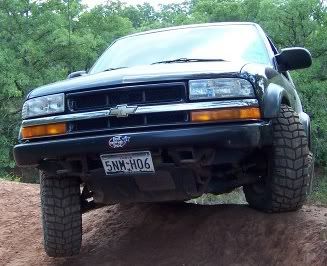

The Yota IFS is different... but explain to me why it benefits from disconnects, where the h3 won't?

Here's a rodeo with similar suspension system, (T-bar)... disconnected but stock otherwise... look at the individual articulation. The H3 would be sitting on a hard angle on the same rock.

attachment.php


I just want to know what is different about suzuki, ford, toyota, etc, that makes it work for them, but not for us. If it really is an issue, there's got to be something specific about what makes this different.


here's an S-10... should be pretty similar (not a GM guy, so I'm not assuming I'm not full o poo here :D)

TonysBlazer.jpg
 

elripster

Well-Known Member
Messages
111
Location
San Diego
These are multilink SLA (short/long arm) suspensions. The yota's used to have their torsion bars attached to the upper control arm while just about everyone else attached theirs to the LCA or used coils. The sway bar functions exactly the same on the yota as it does on every other suspension solid axle, TTB, SLA... by trying to make the wheels move together rather than independently. So what appies to the yota's as far as the sway bar applies here.

GM made our suspensions with about 2X the flex window of a torsion bar IFS yota. That's why you can't get much more out of it. They already did that. Toyota used the short t-bars and with the angular reduction in leverage that goes with the shorter UCA they couldn't even flex to their bumpstops without lifting a wheel. Sure the sway bar helped but they were really hurting. Here you can disconnect the bar and flex the front end wing to wing no sweat with decent compression out of the jounce bumper.

Frank
 

06 H3

a.k.a. "The Jackal"
Messages
9,505
Location
Meridian, ID
will changing spring rates of the t bar. For example going to an alpha t bar help with flex or steep climbs seeing it more load on the front end?

What is the max travel of the stock H3 halfshaft? Im assuming its much more then the shocks allow.

I really need to contact the guy on pirate who had that soa/ rancho rig. That thing flexed so well!

Sent from my DROIDX using Tapatalk
 
Top